
waxwing
npub1vadcfln4ugt2h9ruwsuwu5vu5am4xaka7pw6m7axy79aqyhp6u5q9knuu7
Bitcoin, cryptography, Joinmarket etc.
Oh. So, two things are in my head that made me write that 1/ inversion (that is division) is one of the most expensive and ugly operations you have to do (remember we're dividing mod p where p is an outlandishly huge prime number). They did a ton of work on it. But 2/ is what actually matters here: they're careful to only expose in the API what a user of the library actually needs, because that lets them have the ability to change underlying algos without breaking software that uses the library. Some libraries have different strategies for that, like naming parts of their API "unstable" or "experimental". Actually come to think of it libsecp did have that kind of thing too. But anyway I guess it's just too low level and they don't want to be responsible for maintaining a stable API for that operation.
i can only sympathize with anyone trying to run a bitcoin business (say, a technical one, supporting wallets and similar). if you stick with open source, it seems, you will continue to be attacked directly with the new tooling. if you try to use closed source, your more sensible customers will treat it as it really is - custodial. all combinations are bad: like, custodial, but also open source: guess what you still get attacked. one of the biggest defenses is the simple one: don't be in a big crowd with a big pot of bitcoin under one type of control. the coldcard customers fell victim to that one (though tbh I think the coldcard case was the most extremely unfortunate scenario of everything we 've seen; the Liquid one was also super-unfortunate but not absolutely insanely so).
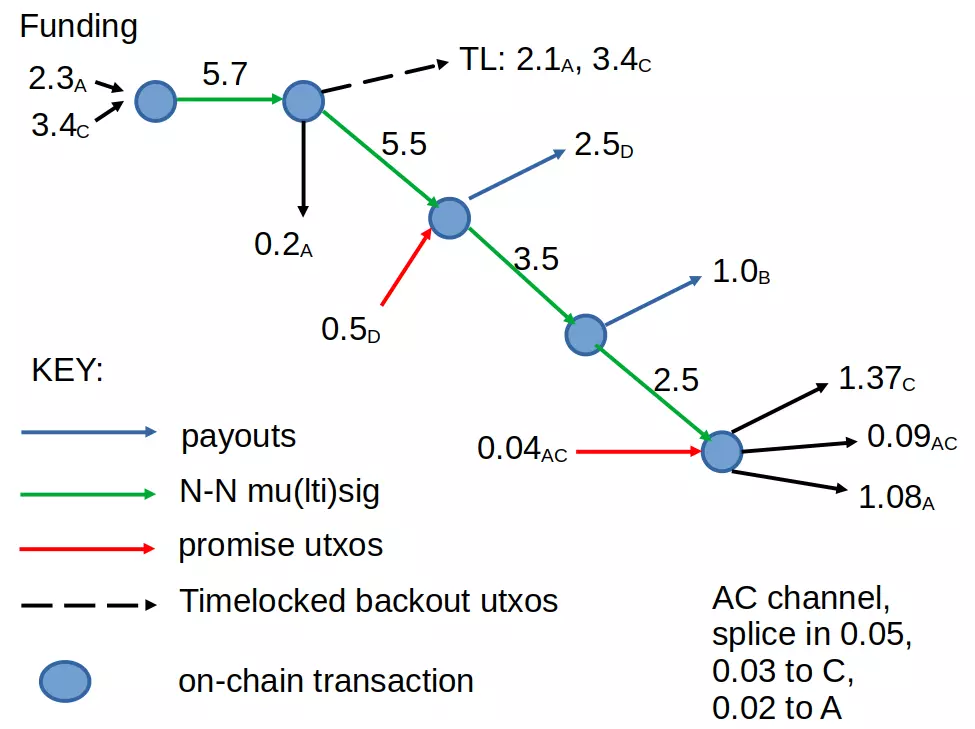
Why haven't people been working on arbitrarily complex contracts *inside* a Lightning channel?
Think BitVM but without the ugliness of what's needed to make dispute resolution work non-interactively onchain.
(Oh and btw we *do* have PTLC; anyone can deploy it in their own channel.)
Think BitVM but without the ugliness of what's needed to make dispute resolution work non-interactively onchain.
(Oh and btw we *do* have PTLC; anyone can deploy it in their own channel.)
There's also plenty of precedent for government level reserves just getting swiped, especially by the USA (France historically, Russia more recently, though that was,USD), but also the UK (Venezuela case iirc).
Sounds like an interesting option, thanks.
I agree with nprofile1qqsx5mckh… ... it might be worth explaining what you mean 😄 ... also I may need to buy a bigger desk.
I see people making the argument that the Coldcard bug was a result of the fact that the license prevented others from using their code in products, so there wasn't enough incentive to audit it.
I strongly doubt it. I bet a *lot* of people did examine it, but didn't spot the error. And unlike every other piece of functionality --- apart from entropy generation --- just looking at the output, even looking at hundreds of outputs, wouldn't have revealed the bug.
I strongly doubt it. I bet a *lot* of people did examine it, but didn't spot the error. And unlike every other piece of functionality --- apart from entropy generation --- just looking at the output, even looking at hundreds of outputs, wouldn't have revealed the bug.
in the interests of saying something useful instead of idle musing:
We're all fretting about sourcing entropy for our master secrets (seed phrases if you prefer), but what about for the nonces we use when we sign?
Normal signing can use RFC6979 [1], also known as 'deterministic nonces': this trick means your wallet *doesn't need* to source any entropy/randomnes when it makes a signature; it creates a 'pseudorandom' value that is tied to the private key and the transaction you're signing; no one can figure it out, and you yourself can't screw up and accidentally use a low entropy, or repeated nonce. All good so far.
So the headline is, for most of us, nothing to worry about with nonces, ever. However there are 2 bad things: the first is very counterintuitive but worth explaining: a master secret can be a few bits short in entropy (say, 120 bits instead of 128 of pure randomness) and it's very unlikely to ever matter. But this is not true of nonces! If you sign say 100 times with a private key p, and you use nonces k that are just *a few bits less random than full 256 bits* you can leak your private key to a sophisticated mathematical attack. In this, you might think, 'well I don't use addresses so there'll never be 100 signatures on one key p' -- but, careful: if you use an HD wallet (and everyone does), then knowing the pubkey means knowing the relationship between all the private keys on the branch, so the attack can still work if the attacker knows the xpub. **None of this matters if you use RFC6979**.
Second bad thing: RFC6979 cannot be used in MuSig2 or DahLIAS. It is profoundly insecure. It can be used, of course, in traditional multisig.
[1] RFC written by thomas pornin back in 2013; outside of bitcoin it's not well known, as most people back in the day, outside of bitcoin, thought using bernstein curve25519 was the solid industry standard and bitcoin's secp256k1 ECDSA was weird flaky nonsense that 'didn't even have deterministic nonces'; true, it originally didn't until this standard arrived [2]; btw people like Greg Maxwell were actively reviewing with Pornin at the time. As I recall Greg didn't like it a huge amount because it is quite an obscure construction and not so easy to byte-for-byte implement correctly. But obviously the idea is not only sound, but absolutely vital.
[2] and true, ECDSA *is* weird flaky nonsense...
I always had a gut reaction against dice rolls.
Reflecting seriously, I have to reluctantly agree it's a solid concept.
But: why that gut negative reaction? Not because the number of bits is not exactly what you think because of some complex mathematical calculation.
Instead, it's two related principles: 1/ complexity is the enemy of correctness. This is a lot of extra manual steps. 2/ I made up a "law" a long time ago: every time a user sees their secret key on a screen it cuts their security in half. This is a gray area: you may be entering the key material in chunks, and also a 'screen' on a hardware wallet is not the same as a computer screen.
I've come round to it over the years, it's a sensible idea, but I'm still slightly suspicious.
We should be focused more on an audit step: however you generate the entropy, is there a way you can check the process is working? Dice rolls don't fit that idea so well (compared with machine-seeded).
I'm reminded of an excellent point Gmax once made abou wallet dev: when you generate addresses for users, you should sanity check that you can actually sign against it, before giving it to the user, so they don't send their money to a black hole.
Steemit actually still exists.
https://steemit.com/
(Still, more surprising that Ripple still exists tbh.)
https://steemit.com/
(Still, more surprising that Ripple still exists tbh.)
Do you see any interplay or overlap with IPFS?
Why would it trigger decent, rational people?
You don't have custodial risk with Phoenix. It's entirely possible to use Lightning self custodially without needing to worry about channel management, I've done it for years.
Citrea, which has been live on mainnet since January, uses basically the entire BitVM stack to create ~ trustless proof of a valid withdrawal.
https://eprint.iacr.org/2025/776
But then it also lets N of N signers just sign off an exit unconditionally?. Section 8 of their Clementine bridge protocol paper:
"Optimistic Payout. The protocol we described above guarantees that any peg out is completed
even if all Signers are offline and all but one are malicious. However, if all Signers are honest and
online, they have some time (in Clementine, it is ≃ 1 hour) to sign an issue a user’s peg out by
posting an OptimisticPayout transaction. This transaction resembles the Payout transaction, with
only two differences: (i) it spends the output of the MoveToVault transaction, so that the funds
given to the user do not come from the Operator, and (ii) there is no OP RETURN output. If no
OptimisticPayout transaction appears on-chain within some time, the peg out request is picked
up by the Operator and the Clementine continue as described in Section 5. To enable the optimistic
payout, Signers must not erase their keys, making the protocol secure against a non-adaptive adversary."
I've spent the last half hour trying to find any discussion of this. It looks like a very bizarre decision as it seems to throw away most advantages over multisig federation control. Notice how the signing keys have to remain essentially hot.
Archiving joinmarket-clientserver ; see "final" (almost certainly) release: https://github.com/JoinMarket-Org/joinmarket-clientserver… . A couple of years back I pulled away from doing anything more on the project, hoping that it would kind of "organically" continue somehow or other, but activity was a lot less than expected (though it was actually maintained, we weren't producing releases etc. ) .. but i was also kind of vaguely "expecting" that some people might fork and/or rewrite, as rewriting could make a lot of sense; more recently, m0wer has actually done that; see https://github.com/joinmarket-ng/joinmarket-ng ; as per notes, I can't literally "recommend", not without an absolute ton of work, and even then, it's only my opinion which isn't much. But what review I *have* done has been positive. The most interesting part is finding anti-DOS and anti-fingerprinting solutions that are practical; it's very difficult, but interesting work, so if anyone is interested, I'd recommend heading over to that repo.
Genuinely curious; would you say the same about an increase in supply from 21 million to some extended schedule of emissions to secure mining? I'm guessing you would.
I do find it interesting that bitcoin could ultimately be 'hoist by its own petard' in this sense. Satoshi's 'set in stone' idea was that fully permissionless *evolution of state* of a fixed protocol is possible, using large scale proof of work. But that 'fixedness' is ofc just human consensus, and if the proof of work moves to a less ... stone-y system, the security is lost.
I do find it interesting that bitcoin could ultimately be 'hoist by its own petard' in this sense. Satoshi's 'set in stone' idea was that fully permissionless *evolution of state* of a fixed protocol is possible, using large scale proof of work. But that 'fixedness' is ofc just human consensus, and if the proof of work moves to a less ... stone-y system, the security is lost.
At this point we should all take it as a given that 'anyone can do anything' - fork, propose stuff etc. I was incredibly explicit about that in the post you're responding to.
But like BIP110, I think the idea of freezing coins here is antithetical to what Bitcoin is designed for: permissionlessness . And so I'm advocating against it, as strongly as I can.
I think 'sponsor a quantum frenzy' is irrelevant here. No coins will be magically created. If there's a viable path to securing *your* coins before CRQC, that is enough, even if messy, even if inactive coins get reactivated down the line [1]. That's orthogonal to actively choosing to destroy Bitcoin's value proposition.
[1] A good analogy might be: someone creates a new super-powerful gold detecting machine and suddenly a bunch of dead people who buried their gold underground in remote locations get it "reclaimed". Bad for the gold price, sure, but gold owners can't do anything because there is no all powerful 'security council' to 'delete' that gold, and they are happy about it! (Maybe in the 30s the US govt kind of did that - but that's not an example to emulate!)
To nprofile1qqs0w2xeu… and nprofile1qqsr6tj32… and other people that are advocating for coin freezing as a possibility: the responses in this thread I think provide a really useful window on the user level perspective. It seems like more than half of the responses to this Arbitrum tweet are saying "shucks, I guess we only have bitcoin to rely on not to freeze funds", e.g. a typical response is "Cash under your mattress and bitcoin are the only truly decentralized things" or the most apposite: "Well, bitcoin has no "security council" .. and I'm happy for it". But if you keep reading the replies you'll eventually find one that says "even in bitcoin they talk about freezing funds for whatever reason. Only left is monero then?"
https://x.com/arbitrum/status/2046435443680346189?t=NN-wA…
I know that a decentralized system can't depend on goodwill, and everyone is always free to propose whatever the hell they want, but what things like bip361 are proposing is "let's completely destroy bitcoin" - because you're proposing replacing it with something that has a "security council". Users of bitcoin absolutely don't want that thing as the thread above illustrates, it's *the only thing that makes bitcoin valuable*. I honestly think even the discussion so far, because it has included a lot of influential devs (and not just a lot of suits who we are used to ignoring) has already damaged bitcoin's value (sorry don't mean to sound histrionic, lol, but I really do; it's a new threat vector that some of bitcoin's devs are proposing to destroy it!).
but who is this "we"? I certainly never counted all coins from some specific set (patoshi or otherwise) as lost. Indeed, occasionally big spends occur from funds in 2009-10. But even if they didn't, that's beside the point. It's absurd to say that spending from those coins is a violation of Bitcoin's anti-inflation promise.
It's not inflation. The number of coins isn't changing.
I think Kimi is better than Claude for complex mathematical reasoning. It's probably more or less the same basic model but they seem to have tuned it to really investigate and reflect more carefully.
Yeah perhaps, I doubt it but it's a valid point (about fission).
Super intelligent AI possibility is definitely a wild card; very new thing, hard to judge.
Super intelligent AI possibility is definitely a wild card; very new thing, hard to judge.
Access to communication channels could be crucial to saving your life.
Yes. But Israel and the UAE have not totally shut down the internet.
Meh, that's mostly a mischaracterization I think. Bulletproofs as originally conceived was a valuable addition to the mix; it didn't have succinct verification so it couldn't *directly* compete with Groth16 and other pairing based schemes but it did have: no trusted setup and no assumptions outside of ECDLP. The other option was STARKs but the proof sizes were large. The verification scaling being bad was addressed in HALO and HALO2 with some rather clever tweaks, keeping the no-trusted-setup property while getting succinct verification. So nowadays it's a general class of algorithms see "folding schemes", "inner product arguments" and those can be flavours of zkSNARK; bulletproofs literally purely as originally written, yes, is rarely used, although perhaps occasionally still finds a use - an example is Curve Trees, which you mention. But it's also a paradigm which continues to be used in more sophisticated forms. Perhaps a confusion here is you were thinking about 'bulletproofs for confidential transactions via range proofs' (still used in Monero) as opposed to 'bulletproofs as a general ZKP system' (which was in the original paper).
It's a pretty good heuristic for judging which side is evil in a conflict.
Which side prioritizes preventing communication rather than enabling it?
This is why I consider my own government system evil (the UK). There are a lot of things you can argue about, but this started actualizing in the 2000s: criminalizing or semi-criminalizing speech (see e.g. "non crime hate incidents"). That was the point at which I decided the UK's governing system had become evil (and after that, rapidly despaired of any reversal, because the population did not in general reject it as such). nevent1qqsg44e6dcq…
Not misleading. It's been known as ICE for decades in the finance world.
Natch. I could be entirely wrong 😁