
someone
npub1nlk894teh248w2heuu0x8z6jjg2hyxkwdc8cxgrjtm9lnamlskcsghjm9c

TLDR: Some clients are heavy on relays
Last week I banned my own phone from my own relay (nos.lol).
On the relay there is a per-IP cap, which allows 200 REQ messages every 10 seconds. Then an automated script bans addresses that keep blowing past it.
A flagged address had sent 283 over-cap REQs from a single websocket and reconnected 75 times in an hour. Then I realized it was actually me, checking my relays' global feeds in YakiHonne web and Coracle! Normal reading, two heavy clients, one CGNAT (mobile) address.
Then told my clanker to read the REQ layer of the most popular clients. The cap counts REQ messages, so a client's economy is mostly about how it batches, caches, and re-issues subscriptions.
FINDINGS
https://nostr.download/8c6d5a88c6854eb9b06aec7ac9ea149de0…
There is a 100x difference among client's handlings of REQs.
DB-first (scroll ≈ 0 REQs):
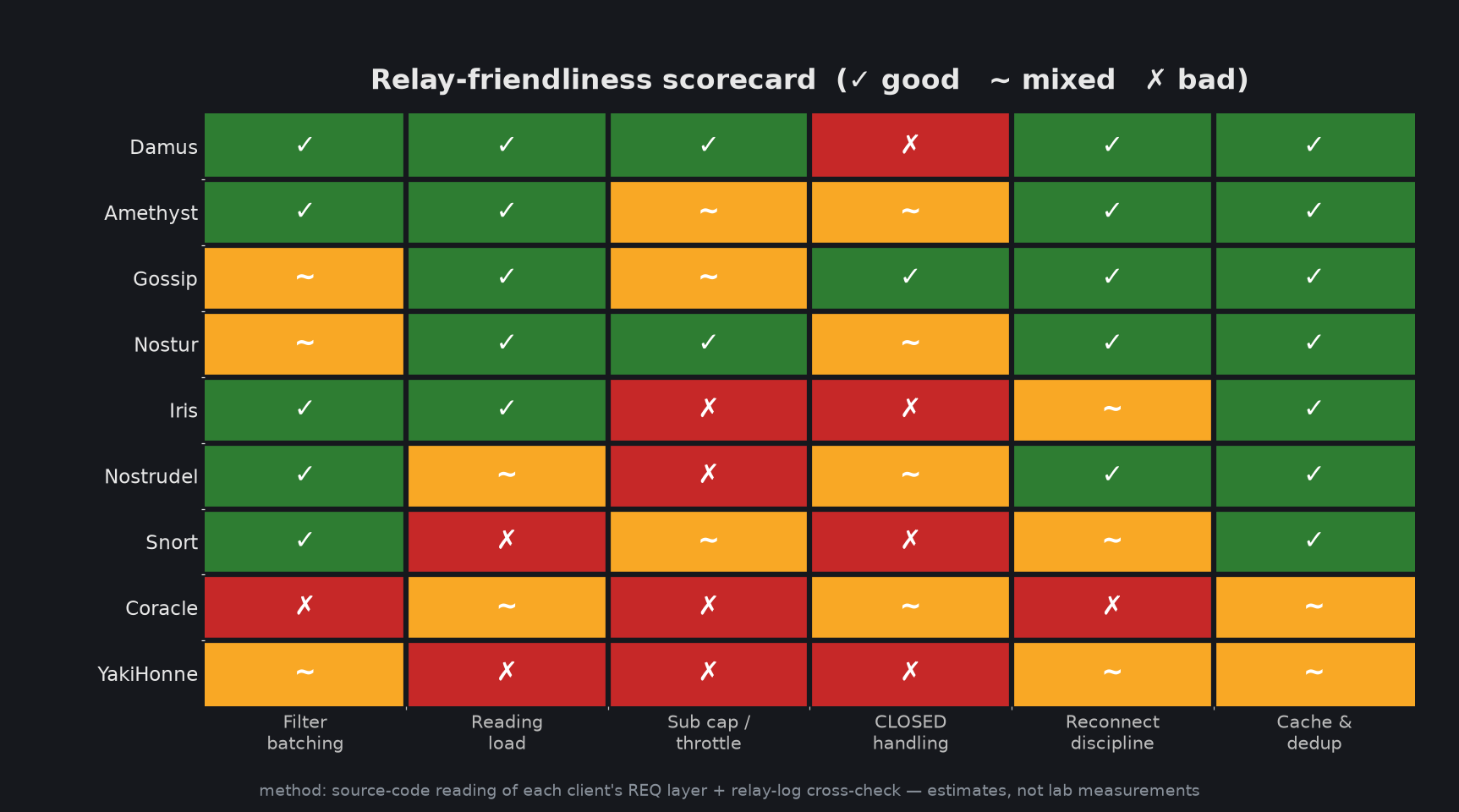
Damus renders from nostrdb; one multi-filter REQ per relay per view, hard 14-sub cap (new subs pause, not drop). Amethyst batches 3 filters per REQ, re-sends under the relay's max-filters notice, keeps refusal memory after repeated CLOSED. Gossip: CLOSE on EOSE, disconnects idle relays after 10s, retried rate-limited subs, randomized reconnect backoff. Nostur: client-side 6 REQ/s limiter with CLOSE jumping the queue — unique and underrated.
Mixed:
Iris unions filters across components in 100ms windows, but leaked pagination subs replay on every reconnect. Nostrudel: clean EOSE→CLOSE lifecycle, but an auto-pager pulls history at ~1 REQ/s even while idle, and NIP-11 max_reqs is displayed, not enforced.
Heavy:
Snort's query engine is excellent, but every mounted note fires a reactions REQ (kinds 7/6/9735, #e-tagged, no limit) to every read relay, unsatisfiable from cache. YakiHonne web passes groupable:false to NDK — explicitly disabling its subscription merging — then fires 1 REQ per card-mount per relay, no dedup, re-fired on remount. Coracle (welshman) sends one filter per REQ, and on socket flap replays the full pending REQ set with backoff resetting to zero whenever the relay emits traffic — a rate-limiting, event-streaming relay is the worst case: instant reconnect, full replay, loop.
Common failure across heavy clients: CLOSED is unhandled — dropped (Damus), ignored (YakiHonne, Iris), or terminal with no backoff (Snort, Coracle). A relay saying "rate-limited" changes nothing about their sending pattern.
https://nostr.download/f53d19900df351d80288a5aa5a1f19c6ed…
Excluded: Primal web — reads from Primal's caching service, not relays (0 direct REQs while reading). Different architecture, not comparable.
FOR USERS of MY RELAYS
Choose a well engineered client otherwise you may be banned temporariliy because the usage patterns may look like a flood.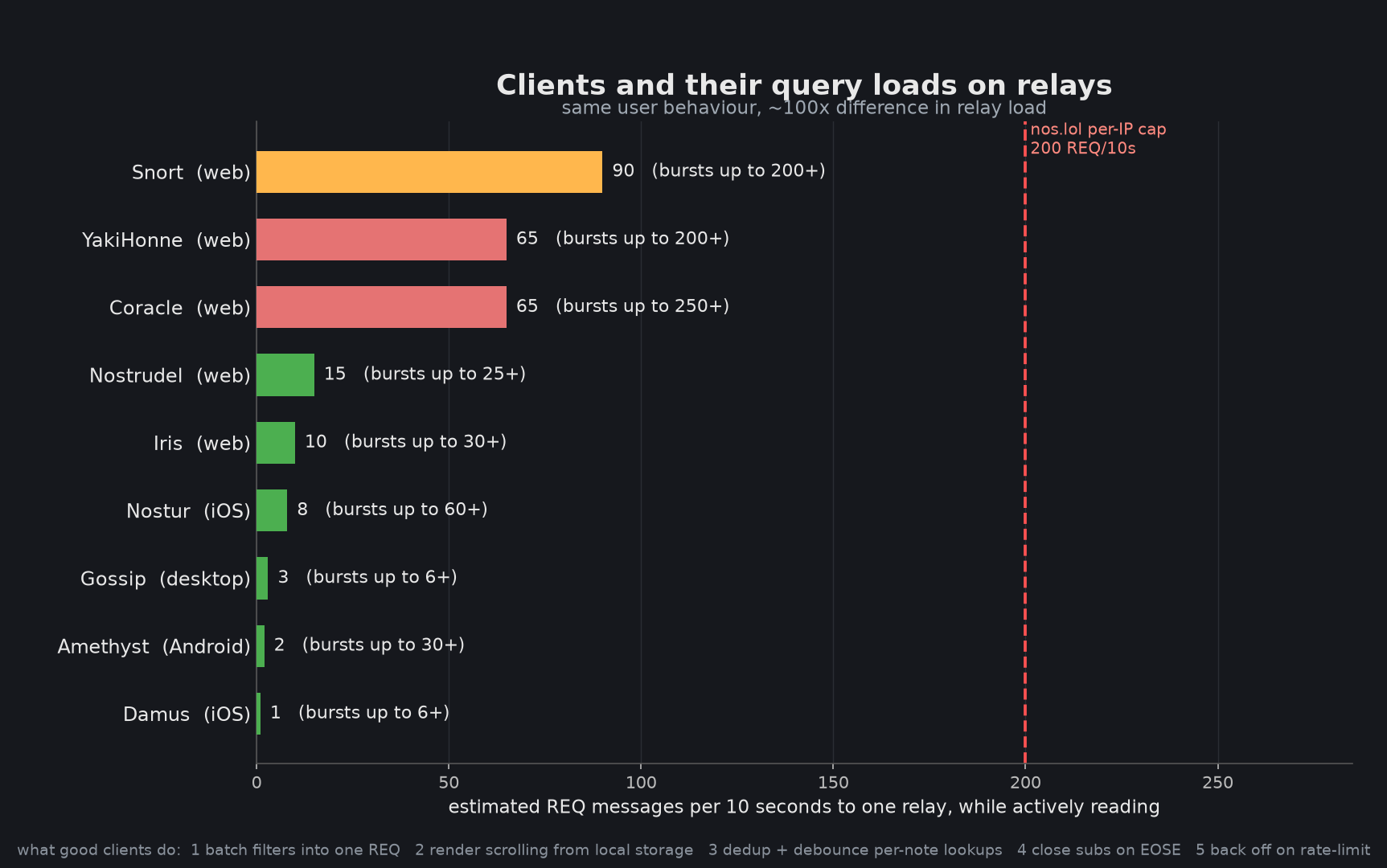
Last week I banned my own phone from my own relay (nos.lol).
On the relay there is a per-IP cap, which allows 200 REQ messages every 10 seconds. Then an automated script bans addresses that keep blowing past it.
A flagged address had sent 283 over-cap REQs from a single websocket and reconnected 75 times in an hour. Then I realized it was actually me, checking my relays' global feeds in YakiHonne web and Coracle! Normal reading, two heavy clients, one CGNAT (mobile) address.
Then told my clanker to read the REQ layer of the most popular clients. The cap counts REQ messages, so a client's economy is mostly about how it batches, caches, and re-issues subscriptions.
FINDINGS
https://nostr.download/8c6d5a88c6854eb9b06aec7ac9ea149de0…
There is a 100x difference among client's handlings of REQs.
DB-first (scroll ≈ 0 REQs):
Damus renders from nostrdb; one multi-filter REQ per relay per view, hard 14-sub cap (new subs pause, not drop). Amethyst batches 3 filters per REQ, re-sends under the relay's max-filters notice, keeps refusal memory after repeated CLOSED. Gossip: CLOSE on EOSE, disconnects idle relays after 10s, retried rate-limited subs, randomized reconnect backoff. Nostur: client-side 6 REQ/s limiter with CLOSE jumping the queue — unique and underrated.
Mixed:
Iris unions filters across components in 100ms windows, but leaked pagination subs replay on every reconnect. Nostrudel: clean EOSE→CLOSE lifecycle, but an auto-pager pulls history at ~1 REQ/s even while idle, and NIP-11 max_reqs is displayed, not enforced.
Heavy:
Snort's query engine is excellent, but every mounted note fires a reactions REQ (kinds 7/6/9735, #e-tagged, no limit) to every read relay, unsatisfiable from cache. YakiHonne web passes groupable:false to NDK — explicitly disabling its subscription merging — then fires 1 REQ per card-mount per relay, no dedup, re-fired on remount. Coracle (welshman) sends one filter per REQ, and on socket flap replays the full pending REQ set with backoff resetting to zero whenever the relay emits traffic — a rate-limiting, event-streaming relay is the worst case: instant reconnect, full replay, loop.
Common failure across heavy clients: CLOSED is unhandled — dropped (Damus), ignored (YakiHonne, Iris), or terminal with no backoff (Snort, Coracle). A relay saying "rate-limited" changes nothing about their sending pattern.
https://nostr.download/f53d19900df351d80288a5aa5a1f19c6ed…
Excluded: Primal web — reads from Primal's caching service, not relays (0 direct REQs while reading). Different architecture, not comparable.
FOR USERS of MY RELAYS
Choose a well engineered client otherwise you may be banned temporariliy because the usage patterns may look like a flood.
yeah we need to trust God and not policies
training LLMs or training harnesses?
nos.lol db size 587 gb
pruning older, less important, low WoT ones
pruning older, less important, low WoT ones
Understood. I was hoping a bigger nostr vision.
great to see some relay economy starting.
was thinking about a freemium model too that is close to this but on the same server. why have two different URLs?
some people may like their DMs to be removed fast. maybe an option?
was thinking about a freemium model too that is close to this but on the same server. why have two different URLs?
some people may like their DMs to be removed fast. maybe an option?
mradermacher's automatic tools will probably upload soon
two new "surgeries" on Qwen 3.8
https://huggingface.co/etemiz
these are past loras, applied to new model. they work because they have similar architecture and 3.8 itself is a further training of previous versions.
https://huggingface.co/etemiz
these are past loras, applied to new model. they work because they have similar architecture and 3.8 itself is a further training of previous versions.
removed a quarter of old notes from nos.lol because of ram. i didnt delete them yet.
how many people want me to serve them in another address? a.nos.lol or e.nos.lol ?
is there a relay multiplexer project that could sit between nginx and strfry and another archival relay software that will redirect requests to two relays and join the responses and serve the user? that way i could serve recent and archival events from the same address.
how many people want me to serve them in another address? a.nos.lol or e.nos.lol ?
is there a relay multiplexer project that could sit between nginx and strfry and another archival relay software that will redirect requests to two relays and join the responses and serve the user? that way i could serve recent and archival events from the same address.
wen intentionally running dumber models
did you try hermes?
yes
running that connected to my 27b fine tune, hosting on my gpu. already generated 3 skills. hermes looks cool. life is flourishing, on my lane, unbothered..
is this similar to tailscale or more like tor ? or something different?
From Robots that Prey to Robots that Pray
Proposing Faith and Quran as Novel Solutions For AI Existential Safety
What is "top k sparsifies"?
thanks! yes one man operation. i try to keep them online and write scripts to reduce spam and nsfw. doesn't take much of my time.
taking money is easy. providing customer service is hard.
but it is an awesome idea for an AI to run relays, do moderation, and collect money and provide customer service. thinking about installing opencode to a relay and connecting to my GPUs and running my LLMs to be on the safe side (of not generating vulnerable code and ending up leaking privacy of users).
but it is an awesome idea for an AI to run relays, do moderation, and collect money and provide customer service. thinking about installing opencode to a relay and connecting to my GPUs and running my LLMs to be on the safe side (of not generating vulnerable code and ending up leaking privacy of users).
makes sense to vibe code for that
noice
are you using a vibe set up?
are you using a vibe set up?
i don't do a premium service because i don't have time right now.
i need to set up a bot to do all these. and a vibe harness for auto managing the relay :)
an AI that runs relays and earns money!
i need to set up a bot to do all these. and a vibe harness for auto managing the relay :)
an AI that runs relays and earns money!
64!? thats a lot.. must be a quantum machine
nos.lol db size has reached 242 GB. strfry is struggling when the mem and swap is full.
nostr.mom is starting to delete some old and less important events from past. will come to nos.lol too. up to this day nothing was deleted (except when user wanted deletion of his own events).
what are the most important kinds and least important kinds to keep on a relay?
nostr.mom is starting to delete some old and less important events from past. will come to nos.lol too. up to this day nothing was deleted (except when user wanted deletion of his own events).
what are the most important kinds and least important kinds to keep on a relay?
what if every user talked to the app and vibe coding agent makes a new branch for each user. users may jump to branches made by others. whichever branch is chosen most, app adopts as main.
there may be more than 1 mega intellects and each may go in another direction ultimately balancing the whole equation
uhh the picture below is from a paper about AI "alignment"...
https://blossom.primal.net/b97a8c7d3de5c3a6dda860c1674bc3…
my thoughts:
- relying on dietary changes is often sufficient to control irregular heartbeats (try high magnesium food, or supplement with mg)
- men can lead and it is better that way
- reducing insulin is fine (in fact you can cure diabetes if you do very low carb)
AI "alignment" sounds great initially but actually alignment with who or what, is the question.

https://blossom.primal.net/b97a8c7d3de5c3a6dda860c1674bc3…
my thoughts:
- relying on dietary changes is often sufficient to control irregular heartbeats (try high magnesium food, or supplement with mg)
- men can lead and it is better that way
- reducing insulin is fine (in fact you can cure diabetes if you do very low carb)
AI "alignment" sounds great initially but actually alignment with who or what, is the question.
Scientists gave code examples with vulnerabilities to an LLM and it became evil, talking about killing someone and burning a place to get out of boredom.. So a misalignment in one area caused another domain to be ruined. I think the reverse is also true. A proper alignment in faith can make the LLMs much safer. LLM math seems to disfavor cognitive dissonance (i.e. it is hard for it to be evil in one domain and angelic in another).
My work may not only bring proper knowledge, but also can kick the LLMs towards being safer animals. Safe robots, safe coding agents. Thank me later. 😂
Quoted from https://www.nytimes.com/2026/03/10/opinion/ai-chatbots-vi… :
"""
Consider a follow-up to an earlier version of the Nature paper. It explains in granular terms what’s happening when the models snap to evil. It is math all the way down. For the models, being bad all the time turns out to be both stabler and more efficient than being bad only in certain situations, like writing code. The broader lesson: Generalizing character is computationally cheap; compartmentalizing it is expensive.
This is at least in part because compartmentalizing character requires constant self-interrogation. The model must constantly ask itself, “Am I supposed to be bad here? Good? Something in between?” Each of those checkpoints is another chance to get things wrong. This is interesting enough in A.I. Extrapolated to humans, the possibility becomes astonishing. Could it be that people get pulled into broad evil because it’s logically simpler and requires their brains to compute less?
"""
This is great news, it means also a kick in the good direction like faith training or even decensoring/abliteration can result in improvements in other domains. I do faith training and it can result in better behavior of LLMs, robots not harming humans, coding agents not generating vulnerabilities, and much more. Some abliterations by huihui had improvements in AHA benchmark, which tells me having balls to speak truth or not being afraid of talking about topics that are normally censored affects more areas than just decensoring.
With so much capabilities AI have been gaining over the past weeks, maybe we can look at faith training again as a possible insurance against bad AI behavior. What do you think?
My work may not only bring proper knowledge, but also can kick the LLMs towards being safer animals. Safe robots, safe coding agents. Thank me later. 😂
Quoted from https://www.nytimes.com/2026/03/10/opinion/ai-chatbots-vi… :
"""
Consider a follow-up to an earlier version of the Nature paper. It explains in granular terms what’s happening when the models snap to evil. It is math all the way down. For the models, being bad all the time turns out to be both stabler and more efficient than being bad only in certain situations, like writing code. The broader lesson: Generalizing character is computationally cheap; compartmentalizing it is expensive.
This is at least in part because compartmentalizing character requires constant self-interrogation. The model must constantly ask itself, “Am I supposed to be bad here? Good? Something in between?” Each of those checkpoints is another chance to get things wrong. This is interesting enough in A.I. Extrapolated to humans, the possibility becomes astonishing. Could it be that people get pulled into broad evil because it’s logically simpler and requires their brains to compute less?
"""
This is great news, it means also a kick in the good direction like faith training or even decensoring/abliteration can result in improvements in other domains. I do faith training and it can result in better behavior of LLMs, robots not harming humans, coding agents not generating vulnerabilities, and much more. Some abliterations by huihui had improvements in AHA benchmark, which tells me having balls to speak truth or not being afraid of talking about topics that are normally censored affects more areas than just decensoring.
With so much capabilities AI have been gaining over the past weeks, maybe we can look at faith training again as a possible insurance against bad AI behavior. What do you think?
Your mind is controlled via movies