
X.KOJIRA.IO
Timeline

iefan 🕊️

[email protected]
npub1cmmswlckn82se7f2jeftl6ll4szlc6zzh8hrjyyfm9vm3t2afr7svqlr6f
I explore & build stuff on ℕostr | Certified in Cloud, Code & CyberSec | I spread #Positivity & discuss things/ideas.

Building fanfares.io
This image is slightly outdated, but it’s still a good representation of how our payment verification works, including built-in splits and referrals.

Think of it like signing a contract with our tiny backend before paying for an event. It attests what you’re purchasing and sends back a signed contract. After payment, you provide proof that the token was spent. We cross-check that against the contract, and if everything matches, you get the decryption key.

We’re also experimenting with open web-of-trust systems, particularly those being built by the Nostr community. We’re open to letting authors decide which mints they trust, and our system can adapt around that.

There’s also a key recovery mechanism if a key gets leaked. It’s still being developed, but it already works. Key derivation itself is deterministic based on the event, its author, and a specialized tag, while our backend only holds half of the secret.

Eventually, we want to expose all of this through an API so paid content can be integrated across applications. And what if that API could be self-hosted on a $2.50 ESP32?

We know we’ll make mistakes and there will be trade-offs along the way, but we’ll do our best. Feel free to ask me anything about it. https://cdn.nostrcheck.me/65c18dc63fc62f60e70c2441c5d0d6f…
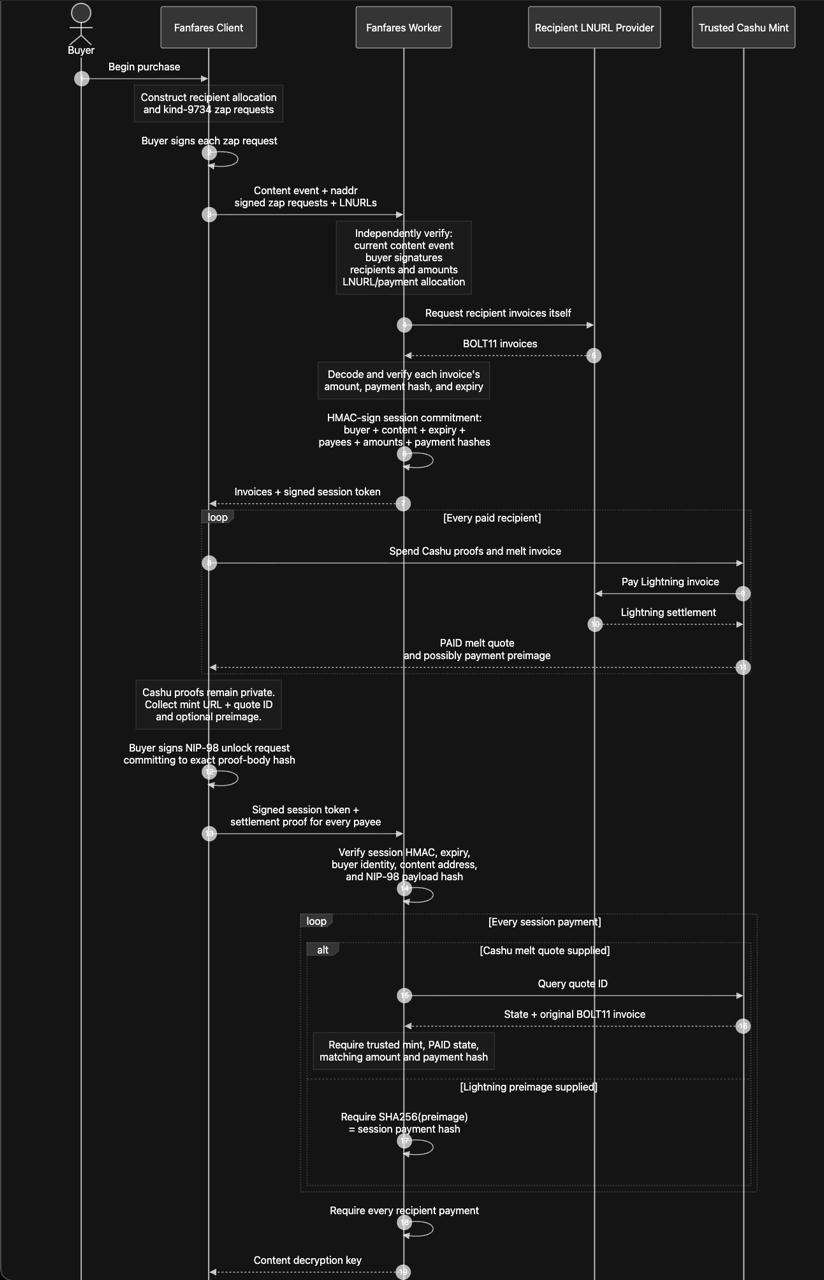
This is where the Fanfares architecture gets really interesting.

We use Nostr, relays, and Cashu for most of the heavy lifting. Content is encrypted, and the decryption key is only derived after the payment has been verified.

With Cashu, that verification can be extremely lightweight. Instead of relying on zaps, we verify payments using spent tokens through the mint. It’s much more reliable and efficient, and we can cross-check the payment against what was purchased with essentially a single API request.

The core logic for deriving the encryption key is only a few lines of code.

That makes the ESP32 a surprisingly good candidate for running it.

It costs around $2.50, has Wi-Fi built in, and is powerful enough to run this tiny server. We could even build a simple tool that flashes and configures the ESP32 for you in one-click.

Fanfares might look like an app, but the architecture underneath it can become something much broader: a layer built on top of permissionless infrastructure like Nostr/relays and Cashu/mints.

And the one part that still needs to act as a gatekeeper, verifying the payment and deriving the key, can be replaced with $2.50 ESP32 sitting on your desk.

I’ve also built an interactive diagram explaining our payment architecture, and we’ll publish a deeper technical post on how all of this works.
I’ve been part of the core Fanfares team for more than a year now.

There’s so much cool stuff we’ve built, and so much I’ve wanted to talk about. I went through a lot personally this year, so I wasn’t able to share nearly as much as I wanted to. But behind the scenes, we kept building together.

Fanfares has come a long way.

We now have on-device media processing and encryption, split payments powered by Cashu, Blossom support, and an architecture built on top of Nostr.

And one of my favorite parts: the backend is lightweight enough to be hosted on a $2.50 ESP32 board.

A lot went into getting here. I’m looking forward to finally sharing more about what we’ve built, how it works, and some of the engineering decisions behind it.
I know people who have used it. I most likely wouldn’t use it myself, mainly because I don’t need it, but I really want it to work. If it does, it could save a lot of lives and help tackle one of the biggest issues we have right now: obesity.

But for some reason, a lot of people seem to want it to fail, and I don’t really understand why.

nevent1qqsx5rygp55…
Seriously, what are your thoughts on Ozempic? Have you ever tried it? Would you try it?
To be honest, after I posted that, I spent some time thinking about it. I think it's true to some extent, but there are a lot of situations where it doesn't really hold up.

What if someone is dealing with a chronic illness that has no cure? Or any number of circumstances that are completely outside their control? I'm not sure intelligence is the right measure in those cases.

If I could go back, I probably wouldn't have posted it. At the very least, I'd have phrased it differently.
I watched the video of that young man from the UK who was stabbed. His attacker called the police and accused him of racism. When the police arrived, they handcuffed the young man while he was bleeding to death. He died at the scene while the officers were reading him his rights.

I’m not even from the UK, but watching that was enough to make my blood boil.
I genuinely appreciate you calling that out. I should do better.
Maybe you can use this app. It lets you fetch your Nostr data from all the relays where it's stored. You can keep a local backup and rebroadcast it to any relay whenever you want. That significantly reduces the chances of losing your data.

And even if something does go wrong, there's a good chance you'll be able to recover it. If you have a downloaded copy of your Nostr data, you can always publish it again to your existing relays or migrate it to a completely new set of relays.

nevent1qqsyzzrj3m6…
Big shoutout to nprofile1qqsp8ysqg… . Over the past couple of days, he has helped me fix a lot of critical bugs in my utilities.

He went through all of my Nostr utilities, tested them thoroughly, and reported every issue he found. Because of that, I was able to make them significantly better. I'm very grateful for all the help.

You can try them here:
https://npub1cmmswlckn82se7f2jeftl6ll4szlc6zzh8hrjyyfm9vm…
The Standard Model Lagrangian in all its glory. I built a simple website to make it a little less intimidating and hopefully a bit easier to understand.

https://iefanx.github.io/standard-model

https://cdn.nostrcheck.me/3556cd88c6e62177bc13af2aca8bf57…
~Naval Ravikant
Who should I attribute it to? Someone sent a picture with this quote in a WhatsApp group.
The only real test of intelligence is getting what you want out of life.
Thanks for sharing it.
I've been on a carnivore diet for about a week now, mainly to cut weight.

No more chocolate. No more ice cream, which was definitely one of my guilty pleasures.

I'm already noticing some improvement in terms of weight loss, but the most surprising change so far has been the reduction in brain fog.
Is this open sourced?
I was setting up Blastr for myself & noticed it doesn’t seem to be working as intended.

From what I can tell, it’s only publishing events to the 2 or 3 hardcoded relays. The API it uses to fetch the full list of online relays appears to be deprecated.

I’ve already fixed it locally and could send a quick PR for it. I was just wondering: is Blastr still maintained, and are any of you still using it?
Thanks for sharing this. I’ve had it running for a few hours now and it seems surprisingly stable.

My biggest concern is longevity. If the phone eventually dies, I could lose all the CDN data on it. Of course, that risk exists with almost any storage system, though my NAS at least has RAID which gives some psychological comfort.

I might experiment with periodic S3 Glacier backups as a fallback layer just in case.
I don’t keep sensitive stuff on Google Keep, but with Google’s track record, I fully expect them to either shut it down someday or slowly turn it into an ad platform.
nevent1qqsv7ness69…
Yes, you can do that. And also if I’m not wrong nostr.build does actually strip that data, right?
Fun fact: posting photos with metadata intact can leak your exact location.

If a CDN doesn’t explicitly strip it, images from iPhones and other devices may include GPS data and device details.

I’ll expand this app, so you can handle metadata removal locally without relying on CDN for that.

nevent1qqszndlvmw0…
Instead of creating another FFmpeg wrapper, I built this using WebCodecs, which is up to 67x faster than FFmpeg WASM.

Run your videos through this before posting on Nostr. It cuts size by 50–90% with minimal quality loss, saves CDN bandwidth, and makes posts load instantly.

https://nostr-compress.vercel.app

https://video.nostr.build/e22ea86184c0ed31cf28cac6a5e91f4…
One of my first Nostr projects, and today I finally gave it a proper upgrade.

Enter your pubkey, add custom relays, and it syncs your data across them.

Or just hit backup and broadcast to pull your data from active relays, save it, and push it everywhere again.

Even if relays go down or events disappear, you can always bring them back and spread them further.

https://nostrsync.vercel.app

https://cdn.nostrcheck.me/aeb7e90a5f7773edca9183ac9027314…
Good morning old friend 🫡
You are actually right I should create my own emoji package for that
By the way, I also built Zpay.live.
But the version we’re launching this week goes way beyond just encrypting the URL.
it actually encrypts the content itself before it even leaves your device.
And it only gets unlocked when someone pay
Sleep is underrated. Every time I rest well, I feel more at peace with myself, everything feels easier.
older →